


English translation: “Factors That Determine the Performance of Cleanroom Air Filters.”
11:18 - 04/03/2026 470
The BMS System in Cleanrooms: A Core Role
What Are DQ, IQ, OQ, and PQ Qualification Documents? Structure, Roles, and a Reference Checklist for Cleanroom Systems
Sustainable Cleanroom Humidity: The Important Role of Water Quality
Factors affecting the recovery of microorganisms from surfaces using contact plates in cleanrooms.
☰ Article Table of Contents
- 1. Quick SEO suggestions
- 2. What is cleanroom filtration efficiency?
- 3. 1) Particle capture capability: the foundation of every evaluation
- 4. 2) Material & design: what is “inside” determines what happens “outside”
- 5. 3) Air velocity, pressure drop, and “real-world” efficiency
- 6. 4) Installation, purpose-based selection, and long-term maintenance
What is cleanroom filtration efficiency?
Cleanrooms are classified based on the cleanliness level of the air, meaning the concentration of airborne particles in a unit volume, and the commonly used international standard is ISO 14644-1 (from ISO 1, the cleanest, to ISO 9, the lower level).
In environments such as pharmaceuticals, medical devices, hospitals, or food testing facilities, microscopic particles can directly affect sterility, product quality, and user safety, so the air filtration system plays a central role.
Therefore, the question of “efficiency” is not just about filtering more, but about filtering the right targets, under the right operating conditions, and maintaining stable performance over time.
1) Particle capture capability: the foundation of every evaluation
The performance of a cleanroom filter is essentially determined by its ability to retain particles, especially ultrafine particles that are invisible to the naked eye.
A commonly cited example to illustrate the difference is that an office space may contain around 500,000–1,000,000 particles/ft³ (equivalent to roughly ISO 9), while ISO 5 allows only about 100 particles/ft³.
Filters are usually “identified” by their capture efficiency at a certain particle size; the smaller the particle, the harder it is to retain, so high-efficiency filters must be optimized to handle extremely fine particles.
The factors that govern particle capture capability often revolve around:
- The structure and density of the filter media.
- The target particle size range of the application.
- The depth of the media layer and the airflow velocity passing through it.

2) Material & design: what is “inside” determines what happens “outside”
Filter media is not simply a layer of “fabric,” but an engineered material designed to retain particles through mechanisms such as diffusion, interception, and impaction.
High-quality media usually has a more uniform fiber structure, maintains performance longer, and withstands the effects of airflow pressure, humidity, or chemical exposure more effectively.
In addition to the media itself, the folding/layering method also has a clear impact: a pleated design increases surface area to capture more particles without excessively “choking” the airflow, thereby extending the service cycle before replacement is needed.
One practical point worth noting in operation is that humans are often a major contamination source, potentially accounting for 70–80% of contamination issues, so selecting the right filtration solution and controlling operations help reduce risks caused by the human factor.
3) Air velocity, pressure drop, and “real-world” efficiency
Efficiency is not only about “how much is filtered,” but also about how air passes through the filter.
If the air velocity is too high, particles may “slip” through; if it is too low, the system may fail to ensure adequate circulation and environmental control within the room.
Pressure drop across the filter reflects the resistance air encounters when passing through it, and this resistance generally increases as dust accumulates over time; an effective filter is one that balances particle capture with a pressure drop that remains within allowable operating limits.
Factors that commonly affect this “aerodynamic” aspect include:
- Filter thickness and total surface area.
- Filter media density.
- Fan capacity and system design.
- Air change per hour requirements.
When airflow remains stable, a cleanroom can usually maintain more stable temperature, humidity, and cleanliness conditions.
Some documents also provide examples of reference air velocities by cleanliness class (for example, around 40 ft/min for ISO 5 and up to 100 ft/min for ISO 1), showing that airflow is a key variable in design and operation.

4) Installation, purpose-based selection, and long-term maintenance
No matter how good a filter is, poor installation (gaps, misalignment, weak sealing) can still create a “bypass” path that allows unfiltered air to pass through openings, significantly reducing overall performance.
Configurations such as ceiling-mounted systems, FFUs (filter fan units), or modular housings all require airtightness and careful installation so that “on-paper” performance can approach real-world performance.
Efficiency must also be understood according to the “purpose of the cleanroom”: medical device manufacturing rooms, pharmaceutical production rooms, or surgical areas have different air quality requirements; this leads to differences in allowable particle levels, safety margins, filter grades, and air exchange requirements.
Choosing an overly “heavy-duty” filter may increase energy consumption and cost, while choosing an insufficient one may affect safety and compliance, so the goal is to optimize according to actual needs.
Finally, performance must be preserved over time: particle buildup increases resistance, reduces airflow, and gradually pulls performance down, so regular monitoring and maintenance are mandatory.
Commonly recommended practices include monitoring pressure drop, replacing filters before severe degradation occurs, checking gaskets/frames, verifying airflow and particle counts, and maintaining records for audits; some recommendations even call for daily monitoring to ensure the cleanroom always remains under control.
In addition, the operating environment (temperature, humidity, chemicals/disinfectants) also affects filter media and service life, so compatible materials should be selected and environmental conditions should be controlled to avoid premature degradation.
 | ANH KHANG CLEANROOM M&E JOINT STOCK COMPANY Hotline: 1900 636 814 - 0902 051 222 Email: info@akme.com.vn Website: akme.com.vn Address: Lot B7 - Xuan Phuong Garden - Trinh Van Bo Street - Xuan Phuong Ward - Hanoi |

12:05 - 28/11/2019 49259
Cleanroom Design and Construction

14:05 - 11/03/2025 24802
GMP and ISO Standard Cleanroom Construction

14:18 - 11/03/2025 13644
ISO Standard Medical Cleanroom Construction

14:13 - 28/02/2025 25092
Electronics Cleanroom Construction

16:15 - 18/03/2021 7517
Warranty Service
16:26 - 28/11/2019 20927
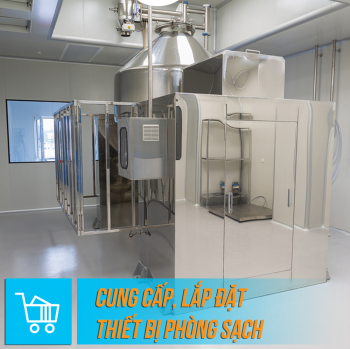
Supply and installation of cleanroom equipment

14:50 - 26/11/2019 7250
Technology Production Line Consulting

16:35 - 19/03/2025 20860