


Reduce the risk of antibiotic resistance with built-in agents.
09:04 - 26/08/2025 520
Explore solutions that reduce the risk of antimicrobial resistance through integrated technology. Learn how they work, their applications in food and healthcare, and their sustainable environmental and economic benefits.
EN 1822 Standard: Classification and Evaluation of the Latest HEPA H13, H14, and ULPA Filters
Latest 2026 Update on ISO 14644 and TCVN 8664 Standards
Sterile Material Transfer Systems for Isolators/RABS.
English translation: “Why Is 2026 the Boom Time for Cleanroom Investment in Vietnam?”
☰ Table of Contents
Reducing Antimicrobial-Resistance Risk Through Integrated Technology
In many high-cleanliness environments such as laboratories, food processing plants, and healthcare facilities, preventing harmful bacteria from growing and becoming drug-resistant is a major challenge. Although traditional chemical disinfection is still necessary, relying on it alone typically delivers only short-lived results—especially in areas that are continuously exposed to the environment and to users.
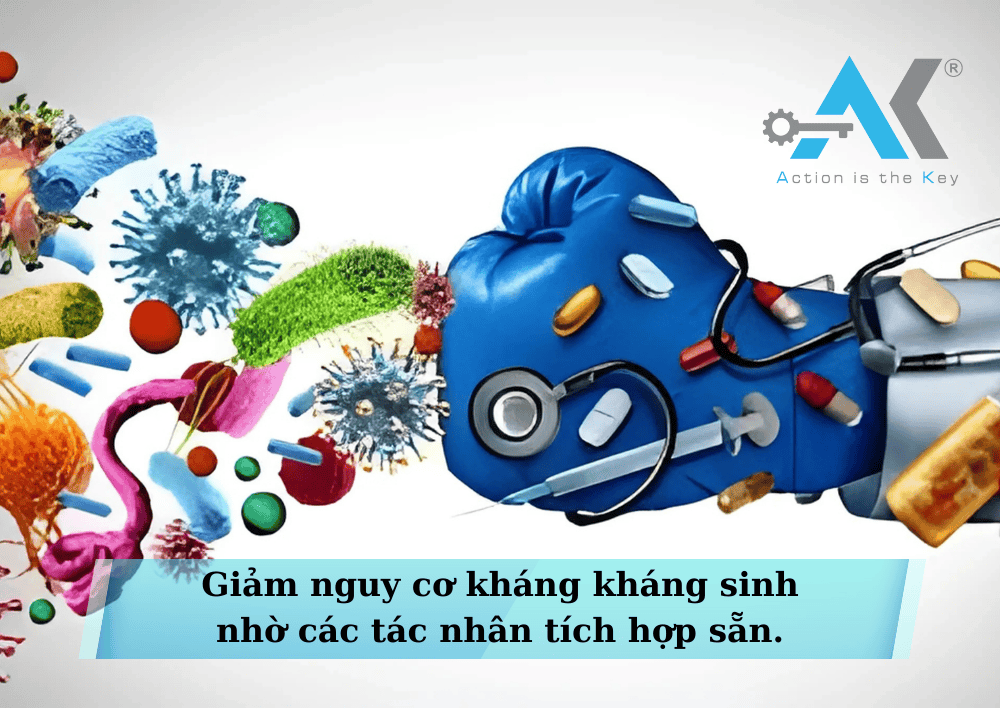
Fundamentals and Mechanism of Action
- How it differs from antibiotics and disinfectants: Antibiotics often have a short duration of action, while disinfectants are only temporarily effective right after application. In contrast, integrated antimicrobial additives work continuously, creating a long-lasting protective barrier on the surface.
- Mechanism of action: When microorganisms come into contact with a treated surface, antimicrobial additives containing silver or zinc ions weaken cellular metabolism—preventing them from absorbing nutrients, expelling waste, and reproducing. This technology can be effective across many materials such as plastics, ceramics, textiles, and surface coatings.
- Long-lasting, non-wash-off performance: Once integrated into a material, antimicrobial agents can maintain performance throughout the product’s lifecycle, without being washed off or losing effectiveness over time.
Impact on Antimicrobial-Resistance Risk
Unlike antibiotics—which can create conditions that enable bacteria to develop new resistant strains—integrated antimicrobial technologies work continuously and do not give microorganisms an opportunity to thrive under favorable conditions. To date, there has been no confirmed evidence showing that microorganisms can become resistant to these agents.
Real-World Applications
In the Food Industry
Microorganisms can enter processing lines through air, water, raw materials, equipment, insects, or people. This can severely affect product quality, trigger recalls, or damage equipment.
According to a poll in a 2021 webinar hosted by Microban, 40% of participants believed that integrating antimicrobial technology into surfaces such as countertops, walls, and floors is the most important. 30% believed the most effective application is in air systems—including filters, ductwork, and insulation materials.
In Healthcare and Commercial Offices
- Sticky mats and sticky rollers equipped with antimicrobial technology help keep frequently-contacted surfaces cleaner—making them suitable for hospitals, laboratories, and cleanroom areas.
- Privacy curtains: A representative example is Summit Medical’s MARLUX curtain, which integrates Microban silver-ion technology to inhibit up to 99.99% of bacterial growth on the surface while maintaining material durability.
-content_1.jpg)
Overall Benefits and the Future
- Reduced food waste: By reducing contact with unhygienic surfaces, fewer contaminated products need to be discarded.
- Water and resource savings: Because the environment can maintain the required hygiene level, cleaning can be optimized without reducing cleaning frequency.
- Environmental and economic value: By combining microbial protection with greener practices, this technology supports sustainable operations and reduces environmental impact.
- Future trend: Under growing pressure to prevent antimicrobial resistance and control infections, integrated antimicrobial technology is expected to play a central role in future hygiene strategies—helping eliminate the “gap” between traditional cleaning events.
Anh Khang’s perspective
Integrating antimicrobial agents directly into materials and surfaces not only improves microbial control and reduces antimicrobial-resistance risk, but also optimizes costs and delivers environmental and production-safety benefits. This is a suitable solution for industries with strict hygiene requirements such as food, healthcare, cleanrooms, and more—and it is expected to remain an important trend in comprehensive hygiene management.
 | ANH KHANG CLEANROOM M&E JOINT STOCK COMPANY Hotline: 1900 636 814 - 0902 051 222 Email: info@akme.com.vn Website: akme.com.vn Address: Lot B7 - Xuan Phuong Garden - Phuong Canh - Nam Tu Liem - Hanoi. |

12:05 - 28/11/2019 49486
Cleanroom Design and Construction
14:05 - 11/03/2025 24960
GMP and ISO Standard Cleanroom Construction
14:18 - 11/03/2025 13871
ISO Standard Medical Cleanroom Construction
14:13 - 28/02/2025 25261
Electronics Cleanroom Construction
16:15 - 18/03/2021 7716
Warranty Service
16:26 - 28/11/2019 21115
Supply and installation of cleanroom equipment

14:50 - 26/11/2019 7427
Technology Production Line Consulting

16:35 - 19/03/2025 20981